





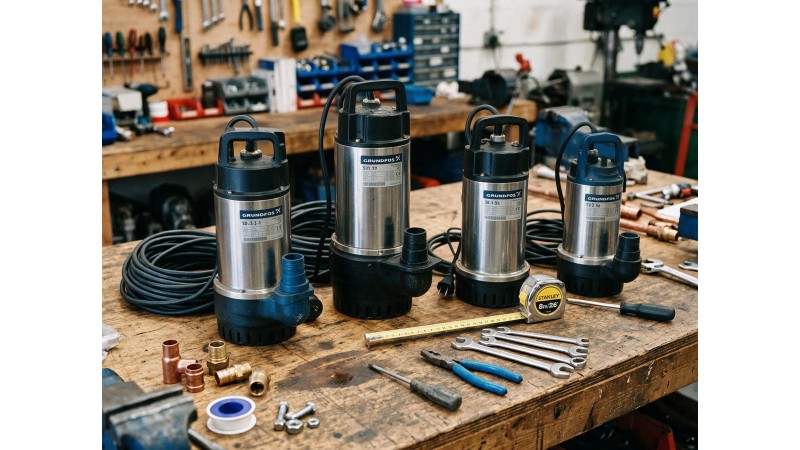
1. Why choosing a well/borehole pump is not “by luck”
The well or borehole pump is often the most important element in the water supply system for a house, villa or small farm. A wrong choice leads to:
-low flow and pressure;
-frequent shutdowns and overheating;
-rapid wear and expensive repairs;
-risk of jamming or inability to retrieve the pump.
In this guide we will go through the real steps for selecting a submersible pump for a well or borehole, with a focus on typical solutions such as SQ, SP, SBA/SB and similar.
2. Types of water sources: well vs. borehole
First, it must be clear from which water source you will be drawing:
2.1. Well
Usually a wider diameter (over 150–200 mm).
Depth often up to 10–20 m.
Can be brick, concrete, shaft type.
In wells, the following are often used:
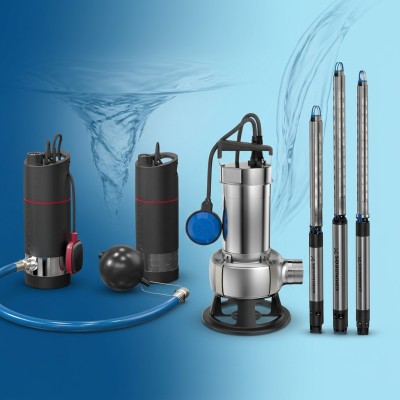
SBA/SB – submersible pumps for domestic water supply;
less often self-priming pumps + suction pipe (if the level is up to ~8 m).
2.2. Borehole
Small diameter – 3", 4", 5" and above.
Depth from 20 to 200+ m.
Tubular, with filters and a head installed.
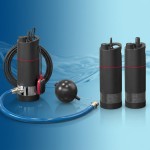
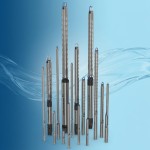
Here the standard are borehole submersible pumps:
SQ/SQE – 3" pumps for domestic boreholes;
SP – a more serious series for deeper and more demanding applications.
3. What data you need to collect before selection
Without this data, the selection is “shooting in the dark”.
3.1. Depths and levels
Total depth of the well/borehole.
Static level – the distance from the ground to the water level at rest.
Dynamic level – the level when the pump is operating (if measurements are available).
These values determine the installation depth and the available water column.
3.2. Borehole/well diameter
Important for choosing between 3", 4", 5" etc.
SQ (3") is convenient for narrow boreholes; SP requires the corresponding diameter.
3.3. Required flow
Number of consumer points (bathrooms, kitchens, irrigation etc.).
Simultaneous use (for example 2 showers + sink + washing machine).
For a standard house, 2–4 m³/h is usually required; for larger properties or irrigation systems – more.
3.4. Required head (pressure)
You need to account for:
- the level difference from the pump to the highest consumer;
- the length and diameter of the pipe network;
- the desired outlet pressure (usually 2.5–4 bar).
4. How to calculate the approximate head
Simplified:
Hобщ=Hгео+Hзагуби+Hналягане
Example for a borehole:
The pump is installed 40 m below ground level.
The highest point in the house is 6 m above ground level.
Desired shower pressure is 3 bar → 30 m.
Losses in pipes and fittings – about 10 m.
Then:
A pump is needed that can provide ~3 m³/h at ~80–90 m head. In the catalogue you look at the characteristics of SQ/SP and select a model whose curve passes through this point.
5. Comparison: SQ, SP, SBA/SB – when to use which?
5.1. SQ / SQE – 3" pumps for domestic boreholes
Suitable for:
narrow boreholes with small diameter (3");
depths up to ~150–200 m (depending on the model);
domestic water supply – houses, villas, small facilities.
Advantages:
compact, easy installation;
built-in “soft start” → fewer shocks;
good balance between price and capabilities.
Disadvantages:
limited flow compared to larger pumps;
more suitable for domestic, not heavy industrial applications.
SQE adds electronic control and constant pressure (via inverter).
5.2. SP – more serious borehole pumps
Suitable for:
deeper boreholes;
higher flow and higher load;
more serious systems – several houses, farm, small business.
Advantages:
wider range of flow and head;
high reliability and long life;
wide choice of configurations.
Disadvantages:
more complex selection and often more expensive installation;
requires a properly executed borehole and power supply.
5.3. SBA/SB – pumps for wells and tanks
Suitable for:
traditional wells, tanks, cisterns;
smaller depths;
domestic water supply with moderate consumption.
Advantages:
“all-in-one” solutions, often with built-in control;
convenient for installation;
ideal for a house/villa with an underground tank or well.
Disadvantages:
not for deep narrow boreholes;
smaller operating limits than SP.
6. Practical selection matrix
I have a narrow deep borehole (3") for a house
→ look at the SQ/SQE series (or equivalent) according to head/flow.
I have a larger and/or deep borehole and more serious consumption
→ SP series + appropriate control (pressure vessel, pressure switch/pressure control, inverter).
I have a well or tank near the house
→ SBA/SB or surface booster (JP + vessel), if the level is up to ~8 m.
7. What to pay attention to during installation
Installation depth – the pump must be sufficiently below the dynamic level, but not “on the bottom” (leave 1–2 m above the bottom).
Check valve – mandatory at the pump outlet.
Cable and protection – correct cross-section, thermal protection and dry-run protection.
Rope/chain for suspension – never leave the pump “hanging” only on the pipe.
Filtration – in case of sand and contamination, consult about suitable filters or special pump versions.
8. Common mistakes when choosing a well or borehole pump
Unknown levels
“My borehole is 60 m, give me a pump for 60 m” – without static/dynamic level and real requirements.
Underestimated or overestimated flow
Weak pump → no pressure during simultaneous use;
too strong pump → drains the borehole, the pump runs on “closed valve”.
No dry-run protection
Especially risky with seasonal use, irrigation systems and shallow water sources.
Wrong pump for the well
Installing a surface booster at a level over ~8 m water column → cavitation and problems.
9. Brief summary – steps for selection
Determine the type of water source – well or borehole.
Measure depths, levels and diameter.
Estimate the required flow and pressure for the house.
Calculate the approximate total head.
Select a pump series (SQ/SQE, SP, SBA/SB) according to the range.
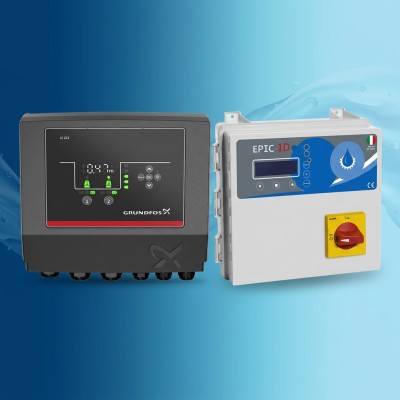
Plan the control – pressure vessel, pressure switch/pressure control, protections.
Ensure proper installation and service.
10. How Online-Pump.com can help you
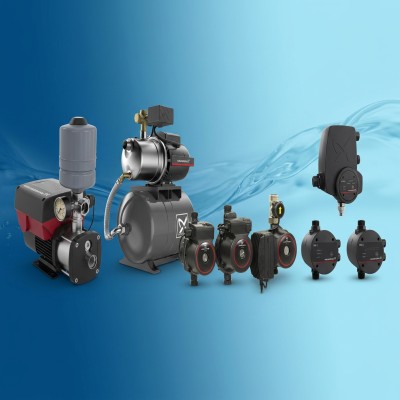
Online selection: in the Pump Catalogue you will find pumps for wells, boreholes and tanks – SQ, SQE, SP, SBA/SB and related accessories.
Consultation: if you send us the data for your well/borehole (depths, levels, diameter, consumption), we can suggest 1–2 optimal options, not “over-pumped” solutions.
Installation and commissioning: the AES‑L team can handle the entire process – from selection and delivery to installation, commissioning and automation setup.
Service: warranty and post-warranty service, diagnostics and spare parts.
Next step:
Record the data for your well or borehole according to the points above.
Browse the categories Submersible pumps for domestic water supply, Submersible pumps for groundwater and Pumps for wells.
Contact us if you are in doubt – the right pump is selected by parameters, not “by hearsay”.
Leave a comment