




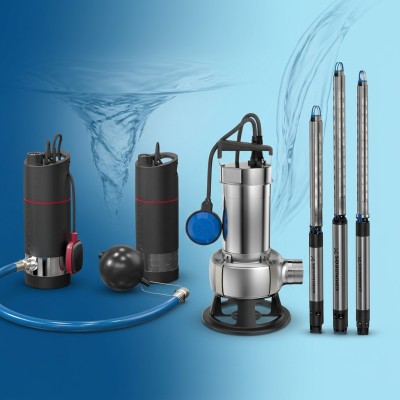
A flooded basement, water collected in a shaft, an overflowing tank, or a sewage problem – in all these cases, “some drainage pump” is not a specific enough answer. Different types of water require different types of pumps; otherwise, the risk is blockage, burnout, or a very short service life of the unit.
In this guide, we will go through three main types of drainage pumps – for clean, dirty, and fecal water – and see when which option is the right one.
1. First: what will you be pumping?
The most important question when choosing a drainage pump is:
What type of water will I be pumping and what particles are in it?
1.1. Clean / slightly contaminated water
Examples:
condensate from air conditioners and boilers;
water from tanks, swimming pools, cisterns;
minor flooding without mud and silt;
water from a well or shaft without solid particles.
Here we are talking about drainage pumps for clean water – smaller permissible particle diameter (usually 3–5 mm).
1.2. Dirty water (drainage)
Examples:
flooded basements/garages with mud, sand, small stones;
rainwater from yards and shafts;
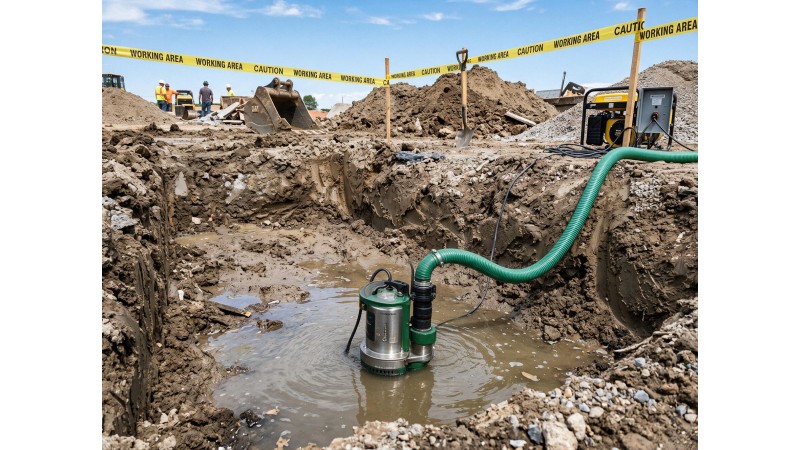
construction excavations with dirty water.
Drainage pumps for dirty water are used, which can handle larger particles (10–35 mm depending on the model).
1.3. Fecal/sewage water
Examples:
wastewater from toilets, bathrooms, washing machines, and kitchens below the level of the sewer;
septic tanks, fecal shafts;
installations where there are solid organic wastes.
Here, fecal pumps are used, often with:
large free passage for solid particles;
a cutting tool (cutter) – for chopping solid materials;
or ready-made compact stations (Sololift-type solutions).
2. Main types of drainage pumps
2.1. Pumps for clean water
Suitable for:
pumping out tanks, swimming pools, wells;
draining clean water without solid particles;
minor flooding in rooms with hard, smooth surfaces.
Characteristics:
small permissible particle size (e.g., up to 5 mm);
often allow very low drainage level (down to a few mm);
lighter and with lower power.
Example applications: KPC, Unilift CC, and similar compact pumps.
2.2. Pumps for dirty water
Suitable for:
basements, garages, shafts with sand and mud;
rainwater with leaves and small debris;
construction excavations.
Characteristics:
larger free passage (10–35 mm);
more robust hydraulic section;
often a housing made of technopolymer or stainless steel.
Suitable models: Unilift AP12/AP35/AP50, Unilift KP, other drainage series.
2.3. Fecal pumps and sewage stations
Suitable for:
wastewater with solid particles;
transporting wastewater over a long horizontal distance or to a higher level from toilets, washing machines, kitchens;
sanitary rooms below the sewer level.
Characteristics:
large free passage (up to 50–80 mm) or
a cutting tool (cutter) – especially important for long pipe routes and smaller pipe diameters;
higher power and robustness;
often part of ready-made stations (Sololift2, Multilift, etc.).
3. What else you need to know before choosing
3.1. Maximum particle size
Each pump model has a parameter “maximum particle size” – this is key:
if the water contains particles larger than allowed → risk of blockage;
if you choose a pump with too “large” a passage for clean water, you lose a little efficiency but gain reliability.
Practically:
clean water: 3–5 mm;
dirty water: 10–35 mm;
fecal: 50+ mm or cutter.
3.2. Head and flow rate
As with other pumps, you need to know:
to what height the water must be lifted (vertically);
how much horizontal distance there is;
what volume of water you want to pump per unit of time.
For drainage tasks, the following usually applies:
in case of basement flooding – flow rate is important (to drain quickly);
for sewage – head is important (to overcome the height and pipe resistance).
3.3. Material and durability
Technopolymer – lighter, cheaper, good for clean and moderately dirty water;
Stainless steel – stronger and more resistant in more aggressive environments, longer service life.
4. Practical scenarios – which pump to choose
Scenario 1: Flooded basement after rain
water with mud and small particles;
you want quick drainage.
Solution: drainage pump for dirty water (Unilift AP12/AP35/AP50, KP, or equivalent), with a sufficiently large free passage and good flow rate.
Scenario 2: Draining a swimming pool or tank
clean water, without solid particles.
Solution: drainage pump for clean water (KPC, Unilift CC, or equivalent), which can drain to a very low level.
Scenario 3: Bathroom/toilet in a basement below sewer level
fecal water + dirty water from sinks, showers, washing machines.
Solution: compact sewage station (Sololift2) or a larger lifting system (Multilift, etc.), depending on the number of sanitary fixtures and usage pattern.
Scenario 4: Septic tank or fecal shaft in the yard
fecal water with solid particles;
there may be greater depth and a long horizontal section.
Solution: fecal pump with large free passage or with a cutting tool (cutter), selected according to head/flow and pipe diameter.
5. Common mistakes when choosing a drainage pump
Choosing by price, not by water type
A cheap clean-water pump thrown into a shaft with mud and sand rarely lasts long.
Underestimating particle size
“Just a few leaves and sand” – but in reality they block the inlet or the impeller.
Incorrect installation
The pump lies on silt/mud → it sucks in sediment and fills with solid particles.
No protection and control
Lack of a float switch to stop at low level – the pump runs “dry” and overheats.
Weak power supply or too thin cable
Especially with more powerful fecal pumps – a correctly sized power supply is required.
6. Short checklist – steps for selection
Determine exactly what type of water you will be pumping.
Assess whether there are solid particles and how large they are.
Measure the required head (vertical + horizontal distance).
Choose the pump type: for clean, dirty, or fecal water.
Check the maximum particle size in the specification.
Specify the material (technopolymer vs. stainless steel) according to the environment.
Provide control and protections – float switch, dry-run protection, access for service.
7. How Online Pump can help
Pump catalog: in the Submersible pumps for drainage water section you will find solutions for clean and dirty water – KPC, Unilift CC, Unilift AP, KP, and others. In the Wastewater stations and Lifting systems sections are the compact and professional solutions for fecal water.
Consultation: if you describe the situation to us (water type, depth, shaft size, pipe route), we can suggest 1–2 models instead of buying “blindly”.
Installation and service: AES-L can handle installation, commissioning, adjustment, and subsequent service of drainage and fecal pumps, so that the system operates reliably and safely.
Practical step:
Before buying a drainage pump, take a few photos of the site (basement, shaft, tank) and note the approximate dimensions and depths. This, combined with the information from this article, is enough to get an accurate recommendation and avoid a wrong choice.
Leave a comment