Available Options
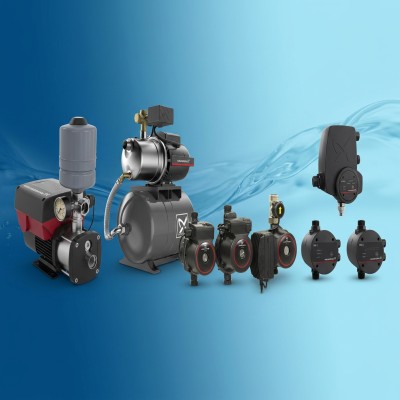
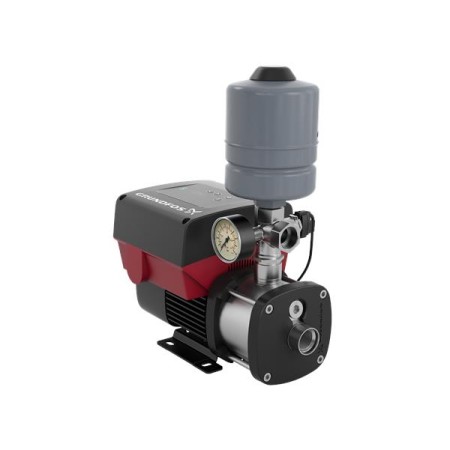
Grundfos CMBE – constant pressure inverter booster pump
Grundfos CMBE is a compact multistage booster pump with electronic control and integrated frequency converter. It adjusts the motor speed according to the current water demand to maintain a stable pressure in the system and reduce electricity consumption at part load.
Main advantages of Grundfos CMBE
- Integrated frequency converter for smooth speed control.
- Maintaining constant pressure with variable water consumption.
- Multi-stage centrifugal design for high pressure and stable operation.
- Permanent magnet motor for high energy efficiency.
- Electronic MGE motor with control and monitoring capabilities.
- Possibility to connect an external pressure sensor.
- Reduced noise level at partial load as the motor operates at lower speeds.
- Lower electricity consumption in variable flow systems.
- Smooth acceleration and reduced hydraulic load at start-up.
- Compact horizontal design with low installation height.
- High-performance hydraulics and mechanical shaft seal.
- Ability to communicate, monitor and adjust via compatible Grundfos solutions.
How does an inverter booster pump work?
When a tap is opened, a shower, an irrigation system or another consumer is turned on, the pressure in the installation begins to change. CMBE receives information from a pressure sensor and, using the integrated frequency converter, increases or decreases the motor speed. This way, the pump delivers only the amount of water needed at the moment and maintains the set pressure more stably compared to a fixed-speed pump.
Applications
- Pressure boosting in single-family houses, villas and apartment buildings.
- Water supply to sanitary facilities, kitchens, bathrooms and garden systems.
- Irrigation of gardens, parks and small agricultural systems.
- Transfer and pressure boosting of drinking and process water.
- Water treatment systems – filtration, softening, ionization and demineralization.
- Washing and cleaning systems.
- Car washes, washing systems and CIP applications.
- Temperature control, cooling and circulation systems.
- Cooling of electronic, medical and industrial equipment.
- Small commercial and industrial applications with variable consumption.
Suitable liquids
- Clean water and non-aggressive aqueous solutions.
- Drinking water and process water with appropriate material implementation.
- Water for irrigation, filtration, softening and technological systems.
- Aqueous solutions with cleaning agents, when materials and seals are adapted to the specific fluid.
General technical features
| Characteristics | Description |
|---|---|
| Pump type | Horizontal multistage centrifugal booster pump |
| Management | Integrated frequency converter for variable speed |
| Engine | Grundfos MGE permanent magnet motor with electronic control |
| Motor energy efficiency | IE5 according to IEC 60034-30-2 |
| Efficiency of the motor + frequency converter system | IES2 according to IEC 50598-2 |
| Control | Speed regulation according to consumption and setpoint |
| Pressure sensor | Possibility to connect an external sensor for constant pressure operation |
| Construction | Compact, close-coupled, with axial inlet and radial outlet |
| Shaft seal | Maintenance-free mechanical O-ring shaft seal with fixed guide |
| Motor protection degree | IP55 in standard versions |
| Installation | On a flat and stable base, with access for servicing and good ventilation |
| Maximum start/stop frequency | Up to 100 on/off cycles per hour |
Installation guidelines
- Install the pump on a flat, stable and immovable base.
- Provide access for inspection, maintenance and service.
- Install the pump in a well-ventilated room.
- Install the piping system so that no air pockets form in the pump housing and pipes.
- For outdoor installation, provide a protective cover against sun, precipitation and condensation.
- When operating with variable flow, it is recommended to correctly position the pressure sensor after the pump.
- Check inlet conditions and NPSH, especially at high temperature, long suction line, high flow rate or suction from depth.
Construction and materials
The CMBE series is based on the Grundfos CM/CME multistage pump design. The material execution can vary depending on the specific model – cast iron, stainless steel AISI 304 or stainless steel AISI 316.
| Component | Material / execution | Practical importance |
|---|---|---|
| Pump housing and inlet and outlet parts | Cast iron EN-GJL-200, stainless steel EN 1.4301 / AISI 304 or EN 1.4401 / AISI 316 depending on the variant | Allows selection according to environment, working fluid and corrosion resistance requirements. |
| Shaft | Stainless steel; in certain versions AISI 304 or AISI 316 | Corrosion resistance and reliable operation of multi-stage hydraulics. |
| Impellers and chambers | Stainless steel EN 1.4301 / AISI 304 or EN 1.4401 / AISI 316 depending on the variant | High efficiency, wear resistance and stable pressure performance. |
| Shaft seal | Mechanical O-ring seal with fixed guide; various combinations available depending on fluid and temperature | It limits leaks and is an important element for the long life of the pump. |
| Elastomers and O-rings | EPDM, FKM or FFKM depending on the design | Fluid compatibility is important with hot water, oils, chemicals or specific process environments. |
| Engine | Grundfos MGE permanent magnet motor with integrated electronics | High efficiency and possibility of speed regulation. |
| Frequency converter | Integrated into the MGE engine | Controls the speed and allows adaptation of performance to the needs of the system. |
| Base | Low-profile mounting base | Compact and stable attachment to a flat base. |
How to choose the material performance?
- Cast iron version: Suitable for standard applications with clean water and normal conditions.
- Stainless steel AISI 304: Suitable for drinking water, water supply, water treatment and most standard water applications.
- Stainless steel AISI 316: Suitable for higher corrosion resistance requirements and certain more aggressive environments.
- EPDM gaskets: Often used with water and aqueous solutions.
- FKM/FFKM seals: Used for specific fluids, temperatures and chemical requirements after technical verification.
Approvals and effectiveness
The CME base series is designed for international use and is available with approvals and markings according to the specific electrical and material performance. The specific certifications depend on the product number, market and options selected. [9]
| Marking / standard | Meaning |
|---|---|
| CE | Compliance with applicable European safety, health and environmental protection requirements. |
| IEC 60034-30-2, class IE5 | Energy efficiency class of the permanent magnet motor with electronic control. |
| IEC 50598-2, class IES2 | Efficiency class of the combined motor and frequency converter system. |
| EuP / MEI | Energy-optimized hydraulics according to applicable European Union requirements for water pump efficiency. |
| IP55 | Degree of protection of standard MGE motors; for condensing environments, a suitable design or protected installation is required. |
| UL NEMA 3R | Specified for three-phase CME motors; applicability is checked on the specific implementation. |
Why does inverter control save energy?
- The pump does not run continuously at maximum speed when maximum flow is not needed.
- When consumption is reduced, the electronics reduce the engine speed.
- Lower speeds mean lower consumption, less noise and lower hydraulic losses.
- Constant pressure increases comfort when using several consumers simultaneously.
- Smooth regulation reduces frequent abrupt starts and stops typical of standard fixed speed systems.
How to choose a CMBE model?
The specific CMBE model is selected based on the required flow rate, total head, number of simultaneously operating consumers, available inlet pressure and required constant pressure. The model designation usually indicates the nominal flow and head series of the pump, but the final selection should be based on the duty point, not just the model name.
What data is needed for an accurate choice?
| Parameter | What needs to be specified? | Why is it important? |
|---|---|---|
| Required flow rate | How many m³/h or l/min are needed when the consumers operate simultaneously? | Determines the pump series – CMBE 1, 3, 5, 10, etc. |
| Geodetic height | The height difference between the water source/pump and the highest consumer. | Determines part of the required pressure. |
| Desired pressure | The pressure to be maintained at the farthest point. | Determines the constant pressure setting. |
| Pipe losses | Length, diameter, fittings, filters, softeners, valves and other resistances. | They must be added to the total required head. |
| Inlet pressure | The pressure before the booster pump or the water level at suction. | Important for the correct operating point, cavitation protection and maximum allowable pressure. |
| Working fluid | Pure water, drinking water, process water, temperature, pH, salts and chemical content. | Determines the required materials, seals and permissible temperature. |
The description is based on the provided catalogue for Grundfos CM/CME – the series on which the CMBE inverter booster concept is based. The specific flow, head, power, supply, materials, seals and approvals depend on the exact CMBE product number. Check the duty point and technical documentation before ordering and installation.